
Why Venezuela’s Situation Does Not Constitute ‘Regime Change’
The recent U.S. operation to apprehend Venezuelan President Nicolás Maduro has revived everyday discussion of regime change. A headline like “Regime Change in America’s Back Yard” exemplified the reaction to the January 3rd event that resulted in Maduro moving from a Caracas compound to a Brooklyn jail.
Many have adopted the term as a simple way to describe ousting Maduro and resolving Venezuela’s crisis, treating the two goals as identical. However, they are not the same.
In fact, from a certain perspective, applying “regime change” to the Venezuela situation confuses the term more than it illuminates it. Here is why.
In international politics, regime change denotes a much more extensive and significant undertaking than merely extracting one leader. It is an external power’s attempt to alter the fundamental system of governance in another country, not just the individuals in charge.
Naturally, this does not rule out the possibility of regime change in Venezuela. It only indicates that replacing Maduro with someone like former Vice President Delcy Rodríguez does not yet meet that threshold—even if, as suggested by U.S. President Donald Trump, she would be a temporary leader.
Grasping this difference is crucial for understanding the stakes in Venezuela’s shift to a post-Maduro era, which may not involve a complete break from the Chavismo ideology Maduro inherited from Hugo Chavez.
A more technical removal
Regime change, as most foreign policy experts define it, involves external forces compelling a profound overhaul of a state’s ruling system. The objective is to reconfigure the holders of authority and the mechanisms of power by altering political structures and institutions, not merely changing policies or personnel.
Viewed this way, the term’s history becomes clearer.
The phrase “regime change” emerged as a means to describe politically imposed transformation from the outside, avoiding older, blunter terminology.
Leaders in past eras would openly discuss overthrow, deposition, invasion, or meddling in another state’s domestic affairs.
Conversely, the newer term “regime change” conveyed a technical and measured tone. It implied careful planning and controllability instead of raw domination, downplaying the fact that it involved the intentional destruction of a nation’s political order.
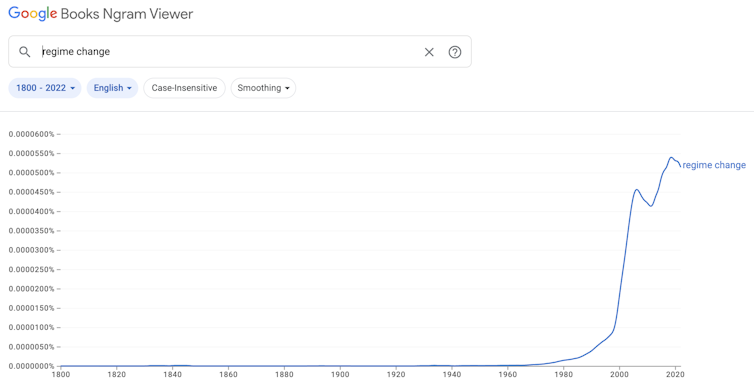
This linguistic choice was significant. Labeling the overthrow of governments as “regime change” lessened the moral and legal burdens linked to forceful intervention.
It also presumed that political systems could be disassembled and reconstructed through skilled design.
The term suggested that once an old order was eliminated, a better one would replace it, and that this shift could be managed externally.
And then came Iraq
Throughout the 1990s and early 2000s, this belief became entrenched within U.S. foreign policy circles.
Regime change became linked to grand projects aimed at substituting adversarial governments with entirely different ruling systems. Iraq stands as the most prominent example.
The 2003 U.S. intervention removed Saddam Hussein, but it also revealed the boundaries of transformation driven from outside.
By barring Hussein and high-ranking members of his long-dominant Ba’ath Party from the new government, it constituted genuine regime change.
Nevertheless, the fall of Iraq’s existing order after the U.S.-led invasion did not create a stable replacement. Instead, it led to a power vacuum that external forces could not manage.
This episode changed the term’s perception. While “regime change” remained in political discourse, its meaning evolved. It became associated with warnings about overextension and the dangers of assuming foreign powers can redesign political systems.
Used in this context, regime change no longer guaranteed control or a solution. It served as a cautionary term informed by past experience.
A fine distinction
Both interpretations are now apparent in debates about Venezuela. Some invoke the term to demonstrate determination and a readiness to dismantle an entrenched system seemingly impervious to reform.
Others hear it and recall the chaos in Iraq, where a regime’s collapse led to division and lasting instability. The meaning assigned to the concept depends on the speaker and their political objectives.
This distinction is important because externally imposed regime change does not conclude with a government’s fall or a dictator’s removal. It triggers a struggle over how power will be reconfigured once the old institutions are taken apart.
This article is part of a series examining terms that are commonly used but rarely explained.
, Professor of Political Science,
This article is republished from The Conversation under a Creative Commons license. Read the original article.
