
Ethereum Whale Accumulation Reaches $350 Million as Retail Investors Hold Back
TLDR
- Since December 26, Ethereum whales have increased their holdings by $350 million, reflecting bullish sentiment.
- A bullish divergence in the Relative Strength Index (RSI) suggests diminishing selling pressure for Ethereum.
- Retail traders are displaying low interest, as indicated by the Money Flow Index (MFI).
- Ethereum’s next price movement hinges on either surpassing $3,390 or maintaining $2,800 to sustain bullish momentum.
Ethereum’s price has experienced a minor decline recently, yet large holders—commonly referred to as whales—have been accumulating the cryptocurrency in substantial amounts. Since December 26, these whales have added approximately $350 million worth of Ethereum to their portfolios. This uptick in whale activity stands in contrast to weaker retail interest, as evidenced by the Money Flow Index (MFI) failing to confirm higher lows. This discrepancy prompts the question: what insights do these whales have that retail investors lack?
Retail Demand Weakens Amid Price Fluctuations
Ethereum’s price has fluctuated over the past few days. Despite the decline, retail demand has not propped up the price as anticipated. The Money Flow Index (MFI)—a metric tracking capital inflows and outflows—has failed to confirm higher lows, indicating that retail traders are not actively purchasing Ethereum at current price levels.
Between December 18 and December 24, Ethereum’s price trended upward, yet the MFI did not follow, registering a lower low instead. This pattern reflects a lack of confidence among retail traders. For stronger demand to be signaled, the MFI must climb above 37. This recent trend of weak retail interest has sparked doubts about Ethereum’s ability to maintain its price without support from smaller retail investors.
Whales Respond With Increased Accumulation
In contrast to the retail slowdown, Ethereum’s whales have been notably increasing their holdings. On-chain data shows that from December 26 to the present, wallets holding large Ethereum amounts have seen an increase of roughly 0.12 million ETH, equivalent to around $350 million at current market prices. Whales typically make such moves based on long-term trends and potential setups, rather than short-term price swings.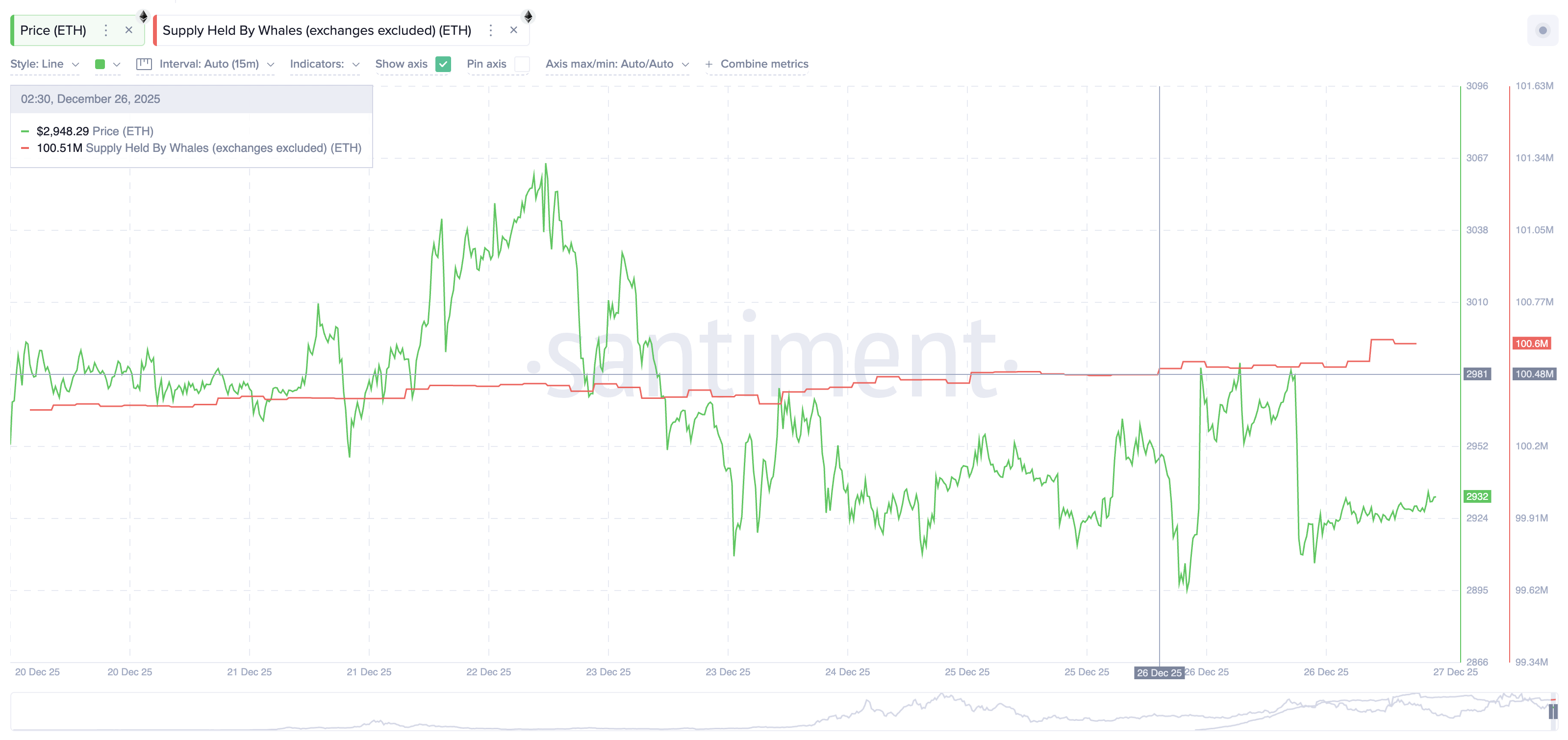
This accumulation suggests that whales are positioning themselves for a potential price shift. Their actions appear to reflect confidence in Ethereum’s price potential, even as retail investors have recently hesitated. A key factor driving this move could be the formation of a potential inverse head-and-shoulders pattern on Ethereum’s chart—a signal of a possible trend reversal if specific price levels are breached.
RSI Bullish Divergence Supports Whale Strategy
One indicator backing the bullish sentiment of Ethereum’s whales is the Relative Strength Index (RSI). Between November 4 and December 25, Ethereum’s price made a lower low, while the RSI recorded a higher low. This is known as a bullish divergence, which generally suggests that selling pressure is easing, even if the price has not yet reflected this shift.

This form of divergence aligns with the inverse head-and-shoulders pattern, a well-recognized technical chart pattern that signals trend reversals. The presence of this bullish divergence bolsters whales’ confidence in their accumulation strategy, as they are betting on a potential price rally once the pattern is confirmed. Yet, the success of this pattern depends on Ethereum breaking through key resistance levels.
Price Zones Determine Ethereum’s Next Move
Ethereum is currently confronting key price levels that will dictate its next price movement phase. A crucial short-term resistance level is $3,050, which Ethereum must recapture to sustain bullish momentum.
If Ethereum successfully breaks above this resistance, the next challenge is the neckline of the inverse head-and-shoulders pattern, situated around $3,390. A break above $3,390 could push Ethereum toward a target price of $4,400, calculated based on the height of the pattern’s head.
However, there is a downside risk. If Ethereum drops below the $2,800 support level, the bullish structure could be invalidated, and the price could decline toward $2,620. Both retail and whale activity will be pivotal in determining Ethereum’s next direction.